Ecological Codes: Constructing Nature in Literature
Dr. Felix Lempp, Prof. Dr. Mareike Schumacher (University of Regensburg), Marie Flüh, M. Ed. (University of Hamburg)
Despite its diverse theoretical orientations, ecocriticism is united by one fundamental assumption: culture and nature are not opposites. Rather, what we understand as “nature” is always a human construction. The project Ecological Codes: Constructing Nature in Literature investigates the specific role that literature plays in this cultural construction of nature. Representations and evaluations of the (apparently) non-human environment are an integral part of literary world-building. In constructing the worlds in which their narratives unfold, literary texts also create historically, generically, and gender-specific conceptions of the environment – an environment with which their predominantly human protagonists are inextricably entangled.
The project explores these literary constructions by combining qualitative literary analysis with quantitative methods from the Digital Humanities. It examines representations of plants, animals, and their habitats in German-language literature of the nineteenth and twentieth centuries. From the quantitative perspective, the project investigates how these non-human life forms are used within literary texts by analysing their frequency, density, centrality, diversity, and other textual features. These analyses also provide the basis for identifying a corpus of texts that are particularly rich in ecological representations.
Close readings relate these quantitative findings to questions of human agency in encounters with plants and animals and to the history of botanical, zoological, and other forms of environmental knowledge. How does knowledge about non-human life shape the development of literary plots? Are literary environments constructed differently depending on the gender of the characters or authors? And how do different literary genres imagine more-than-human worlds?
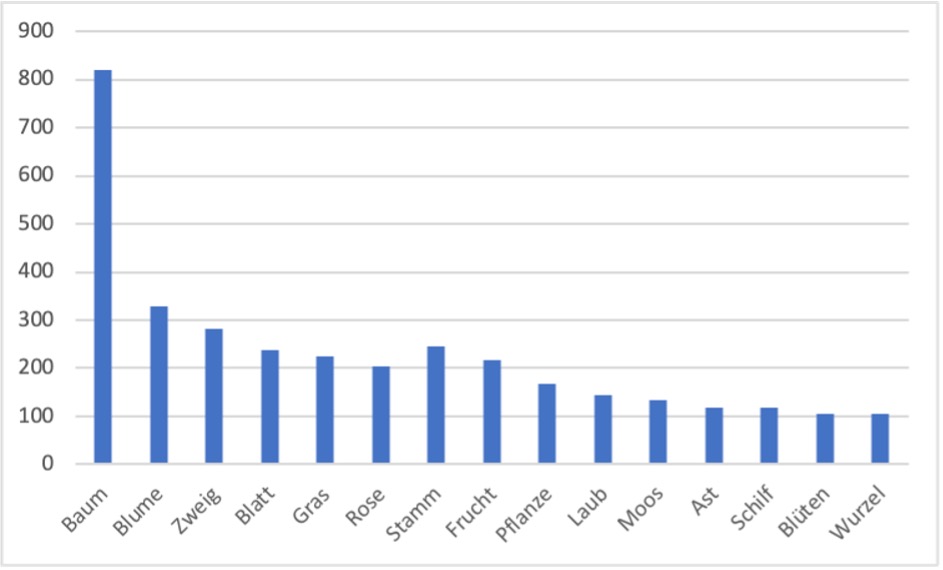
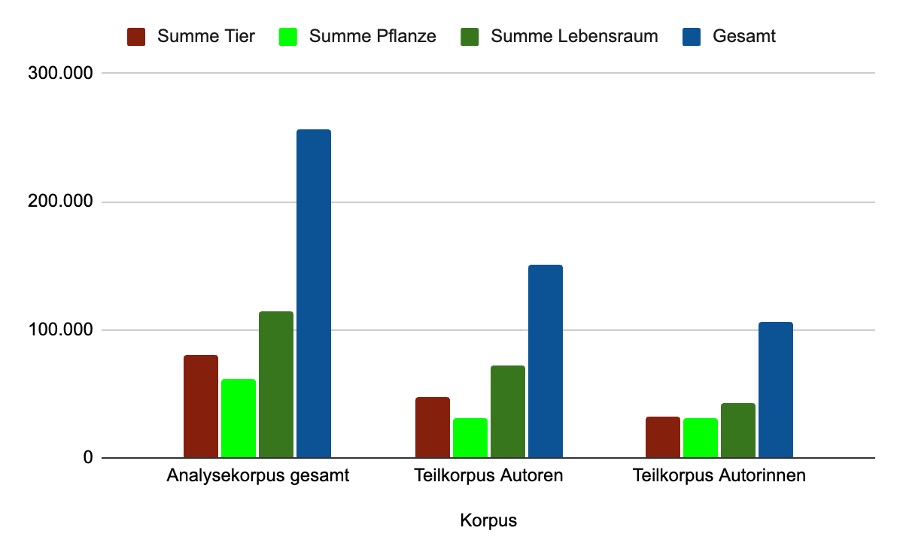
By combining qualitative and quantitative approaches, the project is able to analyse a corpus of several hundred texts, making it possible to address broader questions about the historical development of literary world-building. How does the “biodiversity” of literary texts change over time? Does the number of explicitly named plant and animal species increase or decline? How do the ecological crises of the Anthropocene (re)shape literary environments? By addressing these questions, the project seeks to develop the foundations of an ecological literary history of the Anthropocene.
Get to the project website here
Name research
Family names originated in the area of contemporary Switzerland as early as the 13th century. They therefore bear witness to medieval language and culture. They reflect not only occupations (Diriwächter (gatekeeper), family relationships (Neff (nephew), Oheim (uncle)) or behavior (Ohnsorg (without worries)), but also the relationship between society and the environment. Place names such as Zumthor (to the gate) give an idea of which landmarks were so salient in medieval society that they were used to identify individuals.
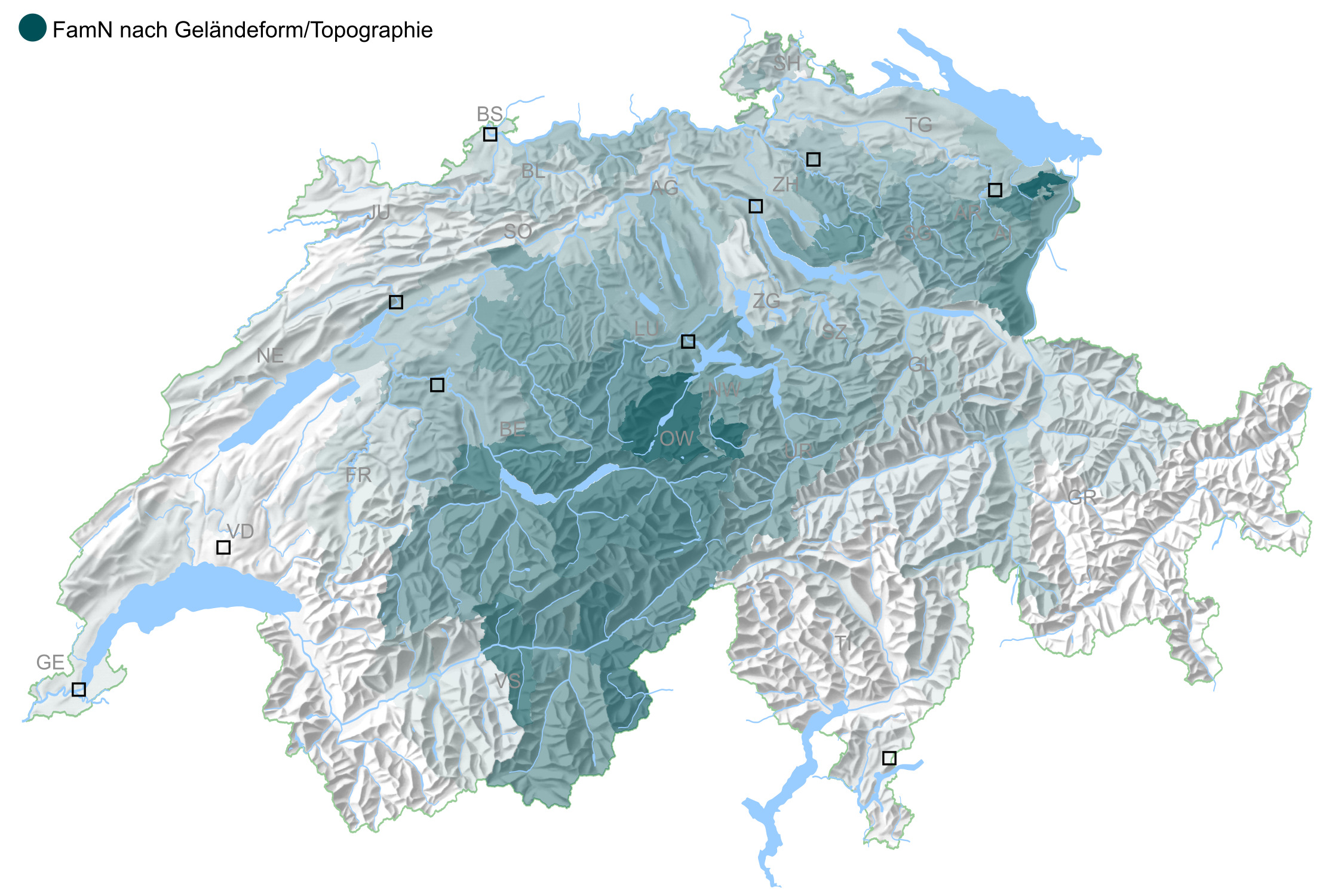
If we map all German-Swiss surnames that refer to sloping terrain, we see – unsurprisingly, but nevertheless impressively – clusters in the (pre-)Alpine regions. The map shows the distribution of over 400 relevant family names before 1800 – including Gfeller (BE, from Gefälle (gradient)) and Zlauwinen (VS, from Löüwine (rock slide)).
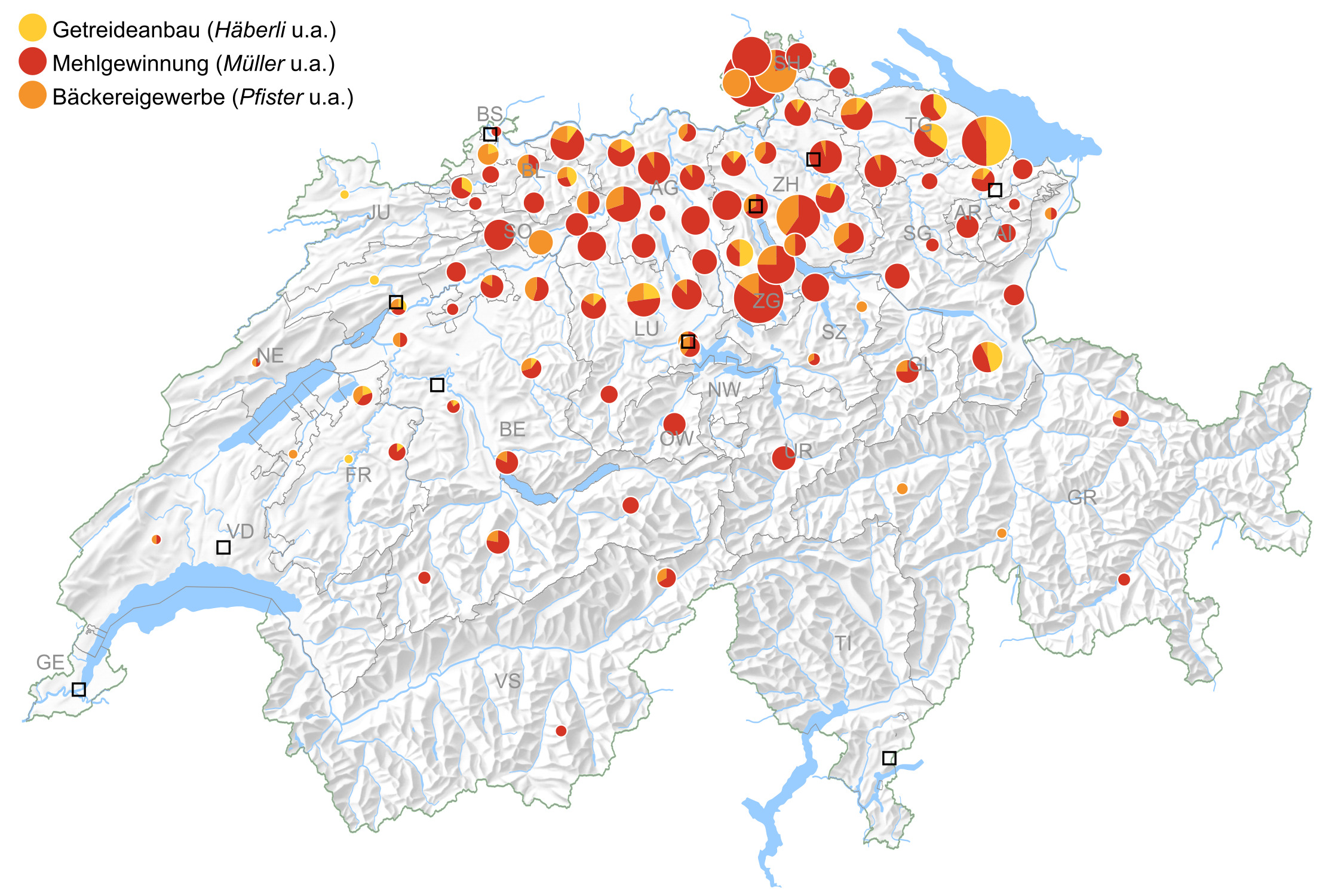
Occupational names related to grain cultivation, flour production, and baking show an almost complementary spatial pattern. The map includes 57 relevant names; larger circles represent higher proportions of these names per district. The northern Swiss Plateau stands out in comparison to (pre-)Alpine regions. On the one hand, this reflects the fact that grain cultivation was only possible to a limited extent in mountainous regions (where livestock farming and milk production were more important); on the other hand, the distribution of names indirectly reflects the higher level of urbanization in the north: in the Middle Ages, commercial bread production tended to be concentrated in cities, while self-sufficiency prevailed in rural areas.
These and other topics will be available from September 2026 in:
Kempf, Luise (Hg.)(2026): Familiennamenatlas der Deutschschweiz. Mit Ausblicken auf die romanischen Sprachgebiete. Bd. 3: Lexik und Benennungsmotive. Bearbeitet von Luise Kempf, Simone Berchtold, Linda Steiner, Esther Loosli, Martina Heer, Selma Vonlanthen. Weitere Beteiligte: Lara Schaub. Tübingen: Narr.
Here you get to the project website.
Data sources:
The map material and geodata are from swisstopo (2022a; 2022b), the name data from the FNB.
FNB = Schweizerische Gesellschaft für Familienforschung (Hrsg.) (2020): Familiennamenbuch der Schweiz. Datenlieferung aus der Online-Datenbank der 3. Auflage von 1989 (https://hls-dhs-dss.ch/famn/) durch das Historische Lexikon der Schweiz (HLS) für die Nutzung im Rahmen des Projekts «Familiennamenatlas der Deutschschweiz. Mit Ausblicken auf die romanischen Sprachgebiete».
swisstopo = Bundesamt für Landestopografie (2022a): Amtliches Ortschaftenverzeichnis mit Postleitzahl und Perimeter. Datenbezug in der Version 01/2022 von der Webseite https://www.swisstopo.admin.ch/de/amtliches-ortschaftenverzeichnis.
swisstopo = Bundesamt für Landestopografie (2022b): swissBOUNDARIES3D. Administrative Einheiten und Grenzen der Schweiz und des Fürstentums Liechtenstein in vektorieller Form. Datenbezug in der Version 01/2022 von der Webseite https://www.swisstopo.admin.ch/de/landschaftsmodell-swissboundaries3d.